
The Loyalty fee
For years, loyalty has been called vincular. Loyalty has remained a concept since the beginning of the 2000s. But brokers and agencies don't care if they talk about loyalty or bonding. In any case, they are clear that, if they do not manage the client's trust well, he will decide to change his mind.
We can call it customer experience, quality of service, or simply affection, in a professional tone, but in the end it's about that. In English they have a perfect word... "Care".
One of the key ideas of the link is that the more products a client contracts, the more resistant it will be to change. This is why we consider the ratio of policies per client one of the best indicators of portfolio loyalty.
And, as in any communication action, the first thing is to know the client and not be mistaken with the proposals.
A few days ago I received a letter from my Banco, the only Caixa that remains in Catalonia. They told me bluntly that they were raising the mortgage differential because I didn't meet the "binding requirements".
The truth is that the concept gives me something to think about.
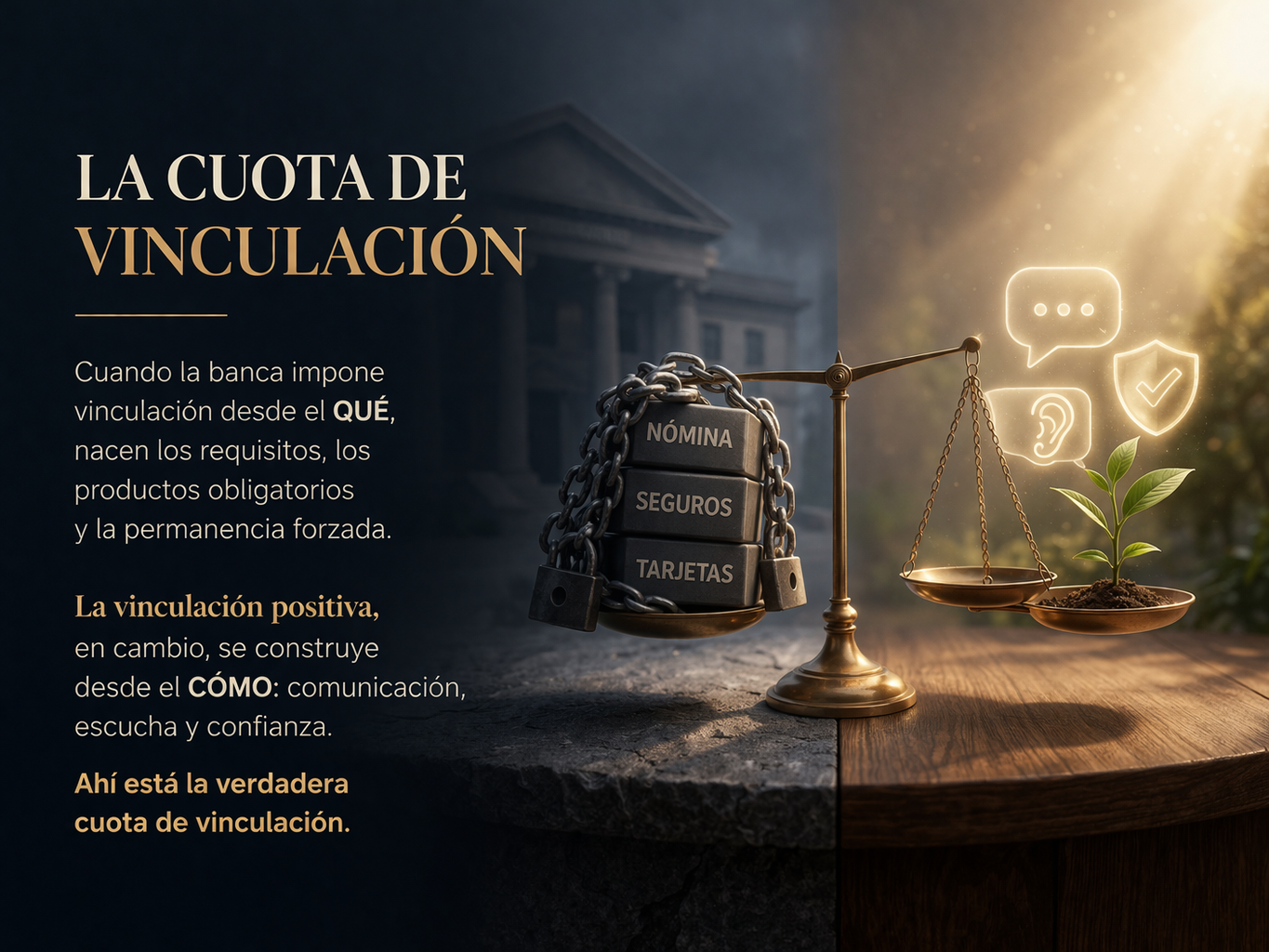
The link in the Bank goes the other way around. It is an indispensable requirement to be fulfilled by the client. Payroll, insurance, cards, whatever you need... It doesn't matter if it fits your needs or your profile. It doesn't matter how your house is. Regardless of your protection needs. It doesn't matter if you need a credit card or not. The requirement is that you have everything. They call it a binding fee, when they should call it a participation fee (within the Bank's margins, of course).
Automation is now added to this voracity for grabbing space in the customer's pocket. A great solution when you want to be efficient, but with which you run the risk of making mistakes if you don't have the ability to fine-tune and customize.
This time I had to get a €40 card (because I already had everything else...) to cover the connection fee. And yet, I think that I am increasingly detached from the entity, its way of doing things and its way of treating clients. Obviously, I have already taken the path of disengagement...
The positive link.
Mediators know it well: gaining trust is difficult. It costs more to maintain it. Increase it even more.
The positive link is not imposed. it is earned
It rests on three very clear pillars:
1. Continuous communication.
- The professionals who connect the most are not the ones who sell the most, but the ones who communicate the most.
- They are present when everything is going well. And, above all, when something goes wrong.
- They use different channels, but with the same objective: to be.
2. Active listening
- It is not about placing products, but about understanding situations.
- Each client has a different patrimonial, family and professional reality.
- Escuchar allows you to adjust the service and protection proposal with precision.
3. Real customer focus
- The negative link says: "If you don't have three products, you will pay more."
- The positive link says: "If you trust us, we will treat you as you deserve."
- It doesn't matter if the customer has one policy or twenty-five. The relationship is not measured by volume, but by quality.
When the experience is consistent, when the advice is honest and when the service responds, the client returns. expand recommend
Not by obligation.
Out of conviction
This process approaches the client and mediator focusing on the HOW (relationship, service, treatment), not the WHAT (product/price requirement).
The imposed binding generates only permanence. Positive bonding generates loyalty.
The true linking fee is not paid with products. Pay with confidence.
And yes, that is the link fee.
